
Every kitchen remodel in Fairfax County arrives at the same fork in the road, usually about two weeks into the design process: what grade of cabinets are we buying? It’s the single biggest line item in the project — 25 to 35 percent of the total budget — and it’s also the decision that quietly controls half of the others. The cabinet grade you choose sets your timeline, constrains or frees your layout, determines how the kitchen feels to use in year twelve, and moves the final number by $20,000 or more in either direction.
The industry sorts cabinets into three grades — stock, semi-custom, and custom — and the names are doing a lot of work. They sound like small steps on one ladder. In reality they’re three different products, made three different ways, for three different buyers. At Kitchen Design Center, we’ve carried lines in all three grades in our Fairfax showroom for decades precisely because no single grade is “best” — but for any specific home, budget, and timeline, one of them almost always is.
This guide is the comparison we walk homeowners through at the design table: what each grade actually is, what it costs in Northern Virginia in 2026, where the construction quality differences hide, and — most useful of all — which grade fits which situation, neighborhood by neighborhood and scenario by scenario.
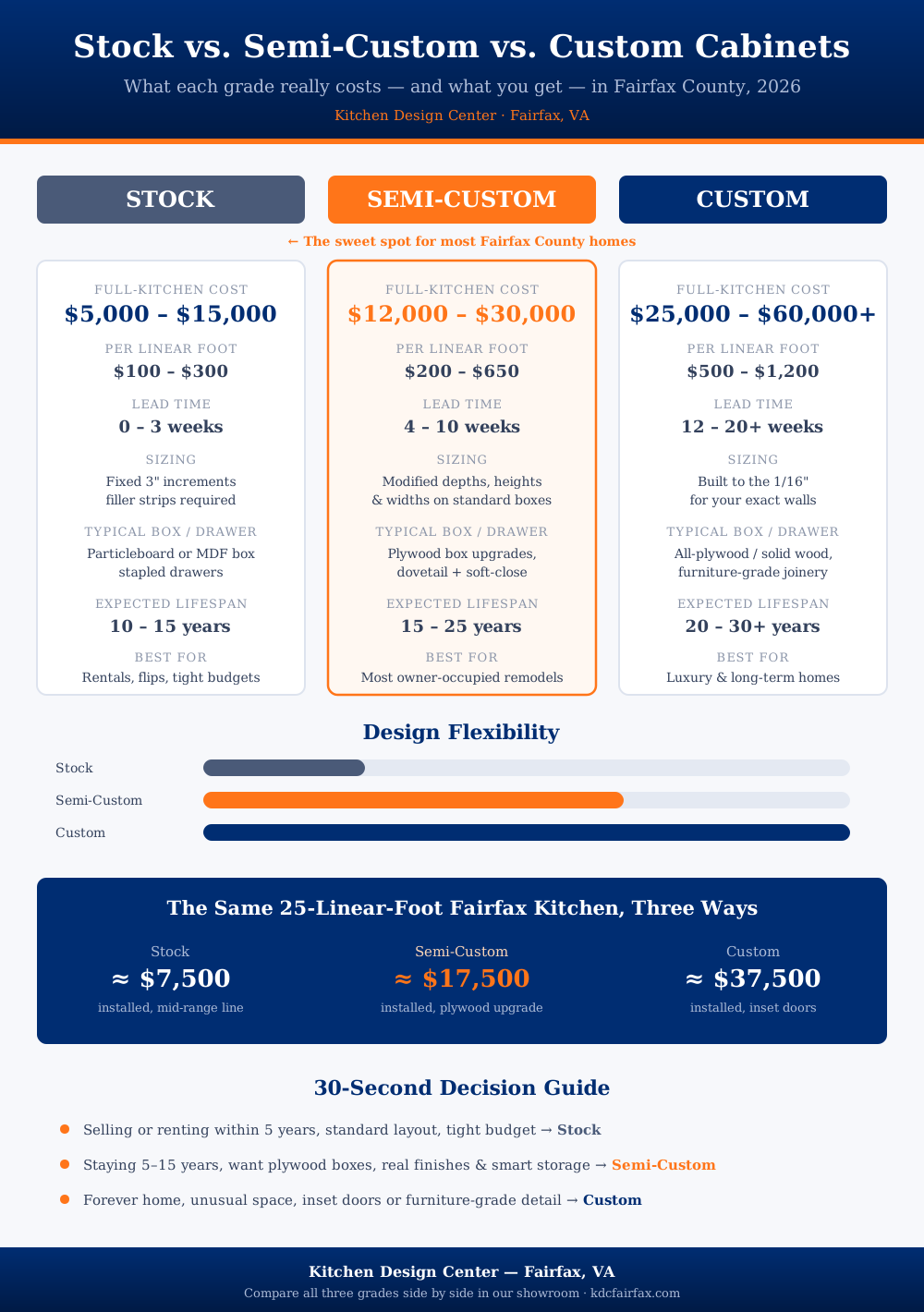
The Short Answer
If you want the conclusion before the evidence, here it is:
| Stock | Semi-Custom | Custom | |
|---|---|---|---|
| Full-kitchen cost (2026) | $5,000 – $15,000 | $12,000 – $30,000 | $25,000 – $60,000+ |
| Per linear foot, installed | $100 – $300 | $200 – $650 | $500 – $1,200 |
| Lead time | 0 – 3 weeks | 4 – 10 weeks | 12 – 20+ weeks |
| Sizing | Fixed 3“ increments | Modified depths/heights/widths | Built to the 1/16“ |
| Typical box construction | Particleboard or MDF | Plywood available or standard | All-plywood / solid wood |
| Drawer construction | Stapled butt joints | Dovetail, soft-close | Dovetail, furniture-grade |
| Door styles & finishes | Limited menu | Wide menu + modifications | Unlimited |
| Expected lifespan | 10 – 15 years | 15 – 25 years | 20 – 30+ years |
| Best for | Rentals, flips, tight budgets | Most owner-occupied remodels | Luxury and long-term homes |
For most Fairfax County homeowners remodeling a kitchen they plan to live with, semi-custom is the sweet spot — enough flexibility to solve the quirks of a real house, enough construction quality to last decades, at roughly half the price of full custom. But “most” is not “all,” and the rest of this guide is about figuring out which side of that line your project falls on.
What Each Grade Actually Is
The names suggest a spectrum of customization, and that’s true as far as it goes. But the deeper difference is how the product is made and sold, and that’s what drives everything else.
Stock Cabinets: Manufactured First, Sold Second
Stock cabinets are built in volume, to fixed specifications, before anyone orders them. They come in standard widths — typically 9 to 48 inches in 3-inch increments — standard depths (12“ uppers, 24“ bases), and a limited menu of door styles and finishes chosen for broad appeal. When you order, you’re selecting from inventory or near-inventory; nothing is being made for you.
That manufacturing model is why stock is cheap and fast, and also why it compromises. Because the boxes must hit aggressive price points at volume, they’re typically particleboard or MDF with a laminate or veneer skin, with stapled drawer boxes and side-mount glides. And because your walls were not consulted when the sizes were set, a stock kitchen almost always includes filler strips — dead spacers that bridge the gap between the last cabinet and the wall. In a small kitchen, six inches of filler is six inches of storage you paid for and didn’t get.
None of this makes stock a bad product. It makes it a purpose-built product: for rental units, investment properties, flips, garage and laundry zones, and genuinely tight budgets, stock cabinets are the rational choice, and the better stock lines — we carry several, including value-engineered lines from Fabuwood and JK Cabinetry — are dramatically better than the builder-grade boxes of twenty years ago, with soft-close hardware and plywood upgrades increasingly available even at this tier.
Semi-Custom Cabinets: Standard Boxes, Real Choices
Semi-custom starts from the same idea as stock — standardized boxes, efficient manufacturing — and then opens the specification book. When you order semi-custom, the manufacturer builds your order after you place it, which means the factory can modify what it builds: reduced depths for a tight galley aisle, increased heights to reach a 9-foot ceiling, custom widths on many lines, dozens to hundreds of door styles, painted and stained finishes on multiple wood species, and a long menu of interior fittings — roll-out trays, deep drawer stacks, spice pull-outs, trash centers, appliance garages.
Just as important, semi-custom is where construction quality takes its biggest jump per dollar spent. All-plywood construction is standard or a modest upcharge on most semi-custom lines. Drawers are dovetailed hardwood with undermount soft-close glides. Hinges are concealed, adjustable, soft-close European hardware. Finishes are baked-on catalyzed conversion varnishes that shrug off a decade of hand oils and cleaning sprays. This is the grade where the cabinet stops being a box with a door and starts being furniture.
The semi-custom tier is the deepest part of our showroom for a reason. Lines like Waypoint Living Spaces, Mantra, ProCraft, and 21st Century Cabinetry cover the value-to-mid band, while StarMark Cabinetry reaches deep into near-custom territory — inset doors, furniture ends, specialty finishes — at semi-custom lead times and prices.
Custom Cabinets: Built From Your Walls Outward
Custom cabinetry inverts the whole process. Nothing exists until your kitchen is measured; then every box, door, and panel is built to those dimensions — to the sixteenth of an inch if that’s what the wall requires. There are no filler strips because there are no standard sizes. There is no door-style menu because any door that can be drawn can be built. Wood species, finish, interior configuration, proportions: all open.
Custom is also where you buy things the other grades simply cannot produce: true inset doors set flush within a face frame like fine furniture, cabinetry that follows a curved wall or an off-square 1940s corner, paneling that makes a refrigerator wall disappear, a hutch scaled precisely to a breakfast nook, or the concealed sculleries and panel-ready appliance walls that define the current luxury market. Lines like TA Cabinetry and our own Millwork Design Center work at this level, alongside StarMark’s upper option tiers.
The costs are real: 12-to-20-plus-week lead times, prices that start where semi-custom ends, and a design process that demands more decisions from you. Custom is the right answer less often than Instagram suggests — and irreplaceable when it is.
Where the Quality Differences Actually Hide
Two white Shaker kitchens can look identical on installation day and age completely differently. The differences that matter are the ones you can’t see from the doorway — so here is where to look.
The Box
The cabinet box (the “carcass”) does the structural work for decades, and its material is the clearest quality marker in the industry:
| Box Material | Typically Found In | How It Ages |
|---|---|---|
| Particleboard | Stock, budget semi-custom | Vulnerable to moisture (one dishwasher leak can swell a sink base); shelf sag under heavy loads; screws strip over time |
| MDF | Stock and semi-custom | More stable than particleboard, takes paint beautifully on doors; still moisture-sensitive at raw edges |
| Furniture-grade plywood | Semi-custom upgrade, standard in custom | Resists moisture, holds fasteners for decades, carries heavy stone-adjacent loads without sagging |
If you take one specification from this article, take this one: in a kitchen you plan to keep, get plywood boxes — standard on custom, a worthwhile upgrade on semi-custom, and increasingly available even on better stock lines. The sink base alone justifies it.
The Drawers
Open any drawer in a showroom and look at the corners. Stapled butt joints — flat panels butted together and stapled — are the signature of economy construction; they loosen under load and rack out of square. Dovetail joints — interlocking hardwood fingers — hold mechanically even without glue and survive thirty years of silverware. Under the drawer, side-mount glides steal an inch of width and feel mechanical; undermount soft-close glides disappear visually, carry more weight, and close a drawer the way a luxury car closes a door.
The Doors and the Finish
Door construction separates grades less than it used to — five-piece doors are available at every tier now — but finish still does. Volume stock lines lean on thermofoil (a vinyl skin that can peel near heat) and simple sprayed finishes. Semi-custom and custom lines use multi-step catalyzed conversion varnishes, baked and cured, with glazes, highlights, and specialty techniques available. The finish is the part of the cabinet your hands touch ten thousand times; it’s also the part that determines whether “white kitchen” still means white in 2036.
The Warranty Tells You What the Manufacturer Believes
Warranties compress all of the above into one signal. Stock lines commonly carry one-to-five-year warranties. Most reputable semi-custom and custom lines carry limited lifetime warranties to the original owner. Manufacturers price risk accurately — a lifetime warranty on a particleboard box would bankrupt them, and they know it.
The 2026 Cost Math, Fairfax County Edition
National averages are a starting point, but Northern Virginia installs above them — our labor market, our permit costs, and frankly our expectations run higher. Here’s how the grades price out locally in 2026, consistent with the full budget breakdown in our Fairfax County kitchen remodel cost guide.
Per Linear Foot, Installed
| Grade | Per Linear Foot (2026, installed) | 25-LF Kitchen | 35-LF Kitchen |
|---|---|---|---|
| Stock | $100 – $300 | $2,500 – $7,500 | $3,500 – $10,500 |
| Semi-custom | $200 – $650 | $5,000 – $16,250 | $7,000 – $22,750 |
| Custom | $500 – $1,200 | $12,500 – $30,000 | $17,500 – $42,000 |
A note on reading this: the ranges within each grade are wide because options drive price as much as grade does. A semi-custom order in a painted finish with an island, glass uppers, and a full interior-fittings package can cost double the same footage in a stained standard spec. This is also why the grades overlap at the edges — a loaded semi-custom kitchen can out-cost an austere custom one.
What Moves the Number Within a Grade
Wherever you land, the same five levers move your cabinet total most:
| Lever | Budget Impact | Notes |
|---|---|---|
| Painted vs. stained finish | +10 – 20% for paint | Painted finishes require more prep and more finish steps |
| Door style complexity | +5 – 25% | Flat slab and simple Shaker cost least; raised panel, beaded, and mitered doors climb |
| Inset vs. overlay doors | +15 – 30% | Inset requires precision fitting; mostly a custom/upper-semi-custom feature |
| Interior fittings | +$150 – $500 per fitting | Roll-outs, pull-outs, dividers — high daily value, adds up fast |
| Island & tall cabinetry | Varies | Tall pantry walls and large islands concentrate more box per linear foot |
Don’t Forget Installation
Installation in Northern Virginia typically runs $50 – $150 per cabinet for standard sets and more for inset custom work, where doors must be fitted to their openings on site. Skimping here is false economy at every grade: a $60,000 custom order hung out of level reads worse than a $12,000 stock kitchen installed dead true. Cabinet installation is unforgiving of shortcuts — it’s the finish carpentry the whole room hangs on, literally, and it’s part of every kitchen remodeling project we run.
Lead Times: The Constraint Nobody Budgets For
Price gets all the attention, but in 2026 — with custom shops carrying deep backlogs — lead time decides as many cabinet purchases as price does.
| Grade | Typical 2026 Lead Time | What Drives It |
|---|---|---|
| Stock | 0 – 3 weeks | In-stock lines ship in days; assembled vs. RTA affects timing |
| Semi-custom | 4 – 10 weeks | Manufacturer backlog, finish complexity, modification count |
| Custom | 12 – 20+ weeks | Shop backlog, wood species availability, finish process, approval rounds |
Three practical consequences follow. First, cabinets are the critical path of a kitchen remodel — demolition shouldn’t start until they’re ordered, and ideally not until they’re in production, because a torn-out kitchen waiting eight weeks for boxes is the most expensive room in your house. Second, if you’re working against a hard date — a baby, a wedding, a listing date — the calendar may make the grade decision for you, and a strong semi-custom line delivers ninety percent of the custom look inside a survivable timeline. Third, order early: the best custom shops in our region book their production slots months out, and the difference between ordering in January and ordering in March can be an entire summer.
Which Grade for Which Home? A Fairfax County Field Guide
After decades of designing kitchens across Northern Virginia, we can tell you the grade conversation goes differently depending on the house. Here’s the honest pattern-matching.
The Builder-Grade Colonial — Burke, Springfield, Centreville, Chantilly
The classic 1980s–2000s colonial in Burke, Springfield, Centreville, or Chantilly has a standard-dimension kitchen that stock sizes fit reasonably well — these houses and stock cabinets literally grew up together. For an owner staying long-term, mid-range semi-custom is the value play: plywood boxes, dovetail drawers, and a finish upgrade transform the room without over-capitalizing the neighborhood. For a rental conversion or pre-sale refresh, a quality stock line with soft-close upgrades is entirely defensible.
The 1960s–70s Rambler or Split — Annandale, Falls Church, Vienna, Oakton
Older homes in Annandale, Falls Church, Vienna, and Oakton are where stock’s fixed sizes start to fight the architecture: bulkheads at odd heights, walls that left square sometime during the Nixon administration, galley aisles where two inches of depth matter. This is semi-custom’s home turf — modified depths and heights solve the house’s quirks without custom’s price, and the modification list is exactly what you’re paying the upcharge for. Reserve full custom for the projects that also move walls and reconfigure the floor plan, where built-to-the-wall cabinetry completes the architectural work.
The Luxury Corridor — McLean, Great Falls, Clifton Estates
In McLean and Great Falls, the calculus inverts. At the $2M+ price point, buyers and appraisers expect designer-grade kitchens; inset doors, paneled appliance walls, sculleries, and furniture detailing are the neighborhood standard, and those are custom (or upper-tier semi-custom) products by definition. Under-building the kitchen in these zip codes costs more at resale than the cabinetry upgrade would have. Custom, or StarMark-tier semi-custom with inset options, is the rational choice — not an indulgence.
The Condo or Townhome — Arlington, Alexandria, Tysons, Reston
Space is the scarce resource in Arlington, Alexandria, Tysons, and Reston condos and townhomes, which strengthens the case against filler strips and for modified depths — a 15-inch-deep run along a tight wall, uppers to the ceiling for storage the floor plan can’t provide. Semi-custom typically wins, with one caveat: some buildings’ delivery and elevator logistics reward the shorter, more schedulable stock timeline for investor units.
The Flip, the Rental, the “Five-Year House”
If the spreadsheet says you’re selling inside five years, the spreadsheet also says quality stock: the payback window is too short for construction quality the next owner will inherit. Spend the savings where buyers look first — countertops, lighting, and hardware — and choose a stock line whose door style photographs like semi-custom. This is the one scenario where we’ll actively talk a client down a grade.
What About Resale? Grade vs. ROI in Northern Virginia
Cabinet grade and resale value have a more nuanced relationship than either the “custom always pays” or the “buyers can’t tell” camps admit. Three patterns hold across the Northern Virginia market in 2026:
Buyers price the kitchen against the neighborhood, not against the catalog. In Herndon, Gainesville, or Haymarket, a crisp semi-custom kitchen photographs identically to custom in the listing and appraises just as well; the extra $20,000 of joinery would return cents on the dollar. In McLean or Great Falls, the same logic runs in reverse — the absence of custom-grade detail is what costs you, because every comparable listing has it.
Condition beats grade at sale time. A ten-year-old semi-custom kitchen with tight doors, working soft-close, and an unyellowed finish outsells a fifteen-year-old custom kitchen with peeling thermofoil-era updates and sagging shelves. This is the quiet argument for plywood boxes and catalyzed finishes at any grade — they’re what “move-in ready” looks like a decade later.
The middle of the market rewards the middle grade. Remodeling-industry cost-vs-value data has shown for years that minor-to-midrange kitchen updates recoup a higher percentage of cost than upscale ones. Translated to cabinets: for the typical Fairfax County home, semi-custom sits at the top of the value curve — enough quality to signal “done right,” not so much that the next owner is paying for craftsmanship they’ll never inspect.
The honest summary: buy stock for the tenant, semi-custom for the market, and custom for yourself. If the kitchen is for you — your mornings, your holidays, your next twenty years — the joinery you’ll touch every day is worth more than any appraisal will ever record.
The Hybrid Strategy: Mixing Grades in One Kitchen
Here’s the move the comparison articles rarely mention: you don’t have to pick one grade for the whole room. Some of the best-value kitchens we build in Fairfax County mix grades deliberately:
- Custom island + semi-custom perimeter. The island is the room’s showpiece and its most dimensionally particular element — the one place custom sizing and furniture detailing earn their price. The perimeter is mostly standard boxes behind standard doors. Guests will never know; your budget will.
- Semi-custom kitchen + stock utility zones. The butler’s pantry, laundry, and mudroom take stock boxes in a coordinating finish at a fraction of the cost, reserving the spend for the room you live in.
- Semi-custom boxes + upgraded fronts. On paint-grade projects, some budgets go furthest with workhorse boxes dressed in upgraded doors and end panels — the parts you actually see.
The key is a designer who plans the mix from the start so reveals, finishes, and proportions align across grades. Done well, a hybrid kitchen reads as one composed room at 60–75% of the single-grade-above price.
Five Mistakes We See Homeowners Make
1. Buying grade names instead of specifications. “Semi-custom” spans a $450-per-foot range; one manufacturer’s semi-custom outbuilds another’s custom. Compare box material, drawer joinery, glide hardware, and finish process — not tier labels.
2. Paying custom prices for a semi-custom problem. If your kitchen is rectangular, your ceilings are 8 or 9 feet, and your wish list is finishes and fittings, semi-custom’s modification menu covers you. Custom earns its premium on problems only custom can solve.
3. Putting the whole upgrade budget into doors while the boxes stay particleboard. The doors are what you see; the boxes are what you keep. Plywood first, glamour second.
4. Letting lead time surprise the schedule. The kitchen that gets demolished before cabinets are in production is the kitchen that eats takeout for two extra months. Order first, demo later.
5. Comparing showroom prices without installation. A quote that looks $4,000 cheaper and excludes install, delivery, crown, panels, and fillers isn’t cheaper. Insist on apples-to-apples, all-in numbers — it’s how we quote every project, and it’s the only honest way to compare.
How to Comparison-Shop Like a Pro
When you visit cabinet showrooms — ours in Fairfax or anyone else’s — bring this checklist:
- Open a drawer, look at the corners. Dovetails or staples? That one glance grades the line.
- Find exposed box edges. Plywood layers or particleboard fleck? Ask what’s standard vs. upcharge.
- Work the hardware. Soft-close doors and drawers? Undermount glides? Adjustable hinges?
- Ask about modifications. Can this line do a 21-inch-deep base? A 42-inch upper? Custom width? The answers tell you where the line really sits, whatever the brochure claims.
- Ask about the finish process. Catalyzed conversion varnish, baked and cured, or spray-and-ship?
- Get the warranty in writing. Lifetime vs. one year is the manufacturer telling you the truth about its own product.
- Get all-in pricing. Boxes, mods, fittings, crown, panels, delivery, installation. One number.
Better yet, put your hands on all three grades side by side. It’s the fastest education in cabinetry there is — ten minutes of opening drawers teaches more than ten hours of reading, this article included.
The Bottom Line
Stock, semi-custom, and custom aren’t three prices for the same thing; they’re three different products for three different jobs. Stock is the rational tool for short horizons and tight budgets. Custom is the only tool for exceptional homes and exceptional spaces. And for the broad middle of Fairfax County — the owner-occupied colonial, the quirky rambler, the townhome you plan to keep — semi-custom delivers the deepest value in the industry in 2026: plywood construction, furniture-grade drawers, real design flexibility, and a lifetime warranty, at roughly half the cost of full custom.
The grade decision gets easy once it’s grounded in your actual house, your actual timeline, and your actual plans for the next decade. That’s a conversation, not a chart — and it’s exactly what our designers do every day at our Fairfax showroom, where all three grades sit side by side waiting to be compared with your own hands. Stop by or schedule a free design consultation and we’ll help you find the grade your kitchen is actually asking for.
Frequently Asked Questions
What is the difference between stock, semi-custom, and custom cabinets?
Stock cabinets are pre-manufactured in fixed sizes (usually 3-inch width increments) with a limited menu of door styles and finishes. Semi-custom cabinets start from standard boxes but allow modifications — changed depths and heights, extended finish palettes, upgraded plywood construction, and interior fittings. Custom cabinets are built from scratch to your kitchen's exact dimensions in any wood, finish, or configuration. The practical differences show up in fit, construction quality, design flexibility, price, and lead time.
How much do kitchen cabinets cost in Fairfax County in 2026?
For a typical full kitchen in 2026, expect roughly $5,000–$15,000 for stock cabinets, $12,000–$30,000 for semi-custom, and $25,000–$60,000+ for fully custom. Per linear foot installed, that's about $100–$300 for stock, $200–$650 for semi-custom, and $500–$1,200 for custom. Northern Virginia pricing runs above the national average because of higher labor and installation costs.
Are semi-custom cabinets worth the extra money over stock?
For most owner-occupied homes, yes. The jump from stock to semi-custom typically buys plywood box construction instead of particleboard, dovetail drawers with soft-close hardware, a far wider finish and door-style selection, and size modifications that eliminate wasted filler space. Those upgrades are exactly the things you notice — and use — every day for the next fifteen to twenty-five years.
How long do stock cabinets last compared to custom cabinets?
Stock cabinets typically last 10–15 years before particleboard boxes, stapled drawers, and thermofoil finishes begin to fail. Semi-custom cabinets with plywood construction commonly last 15–25 years. Well-built custom cabinetry routinely lasts 20–30+ years and can be refinished rather than replaced, which is why it appears in the same house through multiple kitchen updates.
What are cabinet lead times in 2026?
Stock cabinets are available in 0–3 weeks (in-stock lines can ship in days). Semi-custom lines typically run 4–10 weeks depending on the manufacturer and finish. Full custom runs 12–20+ weeks depending on the shop's backlog, wood species, and finish complexity. Lead time is often the deciding factor for homeowners working against a move-in date or a contractor's schedule.
Can I mix cabinet grades in one kitchen?
Yes — and it's one of the smartest budget strategies available. A common approach in our Fairfax County projects is semi-custom cabinetry on the perimeter with a custom island, or stock boxes in a pantry or laundry zone paired with semi-custom in the main kitchen. Because the island is the showpiece and the perimeter mostly holds standard boxes, the mix reads as high-end at a mid-range price.
Do custom cabinets add resale value in Northern Virginia?
In upper-bracket markets like McLean, Great Falls, and Vienna, buyers expect designer-grade kitchens, so quality cabinetry protects your asking price. In mid-market neighborhoods, a well-executed semi-custom kitchen typically returns more of its cost than full custom, because buyers notice finishes and layout more than joinery. Match the cabinet grade to the neighborhood's price point rather than over- or under-building.
What should I look for when comparing cabinet quality in a showroom?
Open a drawer and look at the corners — dovetail joints signal quality, staples signal economy. Check whether the box is plywood or particleboard at the exposed edges. Test the soft-close on doors and drawers, look at how the shelf pins seat, and ask about the finish process (baked-on catalyzed finishes outlast spray-and-ship). Finally, ask what the warranty actually covers — limited lifetime warranties on semi-custom and custom lines are meaningfully different from one-year stock warranties.