

The single biggest risk in a kitchen remodel isn’t the cabinet grade, the countertop material, or even the budget — it’s who you hand the project to. Every disaster story you’ve heard about a remodel gone wrong — the contractor who vanished mid-project, the unpermitted electrical work that surfaced at resale, the deposit that disappeared with the company — traces back to this one decision made too quickly, usually based on a low bid rather than real vetting.
Fairfax County and Northern Virginia have a genuinely competitive remodeling market, which cuts both ways: there are excellent, licensed, insured firms doing exceptional work, and there are also unlicensed operators, out-of-town crews chasing storm-damage cycles, and companies that look professional in a Google ad but can’t produce a current insurance certificate when asked. This guide is the vetting process we’d want a homeowner to run on us, and on anyone else — grounded in actual Virginia law, not just general good advice.
Start Here: Is a License Actually Required?
Yes, and this isn’t optional or a formality. Virginia requires contractors working on any project valued over $1,000 to hold a license from the Department of Professional and Occupational Regulation (DPOR), issued through the Board for Contractors. A kitchen remodel — which routinely runs into the tens of thousands of dollars — falls well within this requirement, no exceptions for “just doing cabinets” or “just doing a small job.”
Hiring an unlicensed contractor isn’t just a compliance technicality. It voids your practical recourse if something goes wrong, it’s a strong predictor of missing insurance, and unpermitted or improperly performed work by an unlicensed contractor is exactly the kind of defect that surfaces during a home inspection at resale — a problem that costs far more to unwind later than it would have cost to hire correctly the first time.
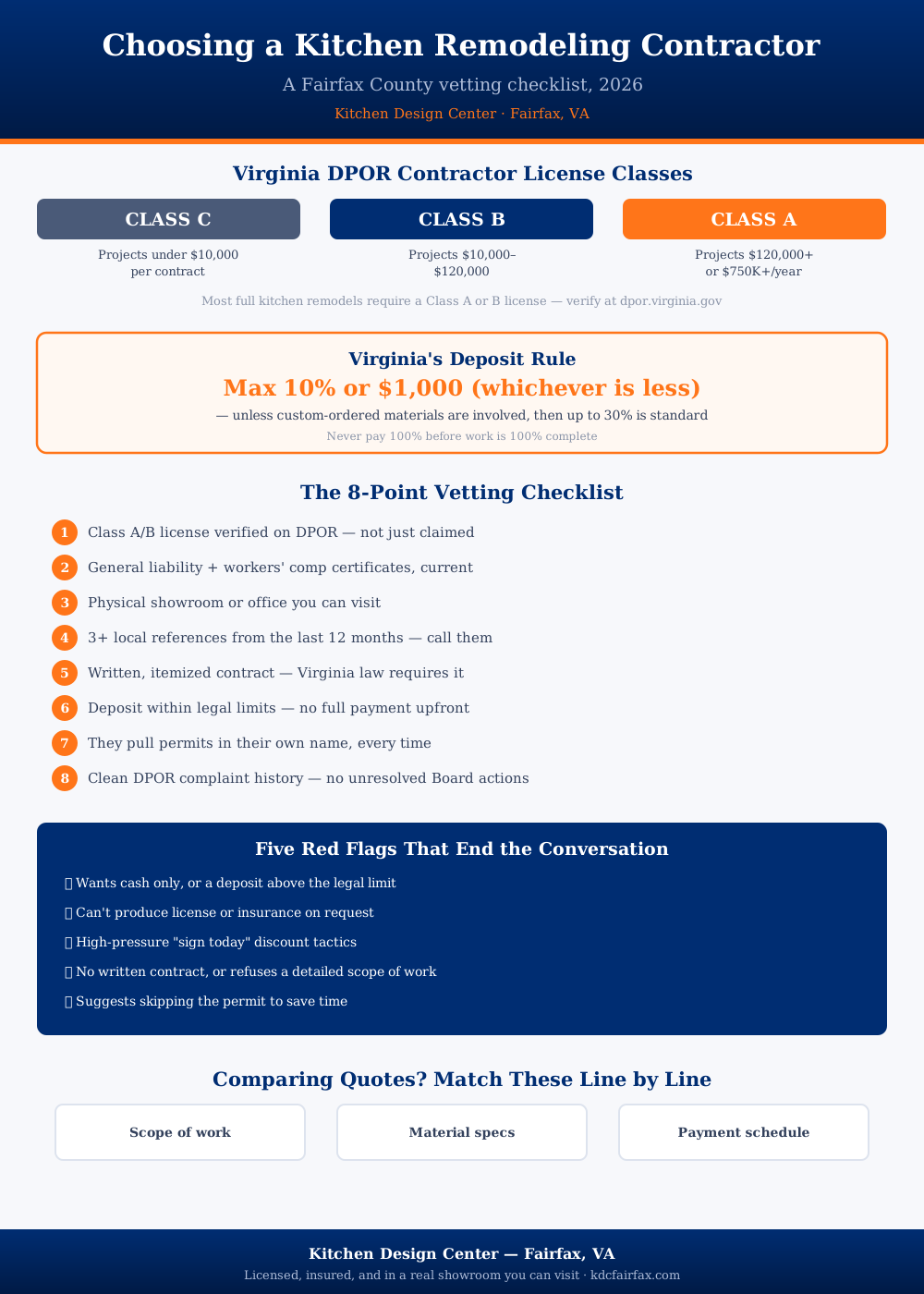
Understanding Virginia’s Contractor License Classes
Virginia issues three classes of contractor license, sized to the value of the work a contractor is authorized to perform. Knowing which class your project requires tells you immediately whether a contractor is even legally qualified to take it on.
| License Class | Project Value Authorized | Requirements |
|---|---|---|
| Class C | Under $10,000 per contract | Lower bar for experience and financial qualification |
| Class B | $10,000 – $120,000 per contract | Minimum net worth of $15,000; financial history reviewed |
| Class A | $120,000+ per contract, or $750,000+ annually | Minimum 5 years of experience; $50,000 surety bond; minimum net worth of $45,000; the most rigorous financial qualification |
Most full kitchen remodels in Fairfax County — once cabinets, countertops, appliances, and labor are totaled — land in Class B or Class A territory. A contractor holding only a Class C license is not legally authorized to take on a project above $10,000, full stop, regardless of how the estimate is structured or how confident they sound about it. This is one of the fastest disqualifying checks available to you, and it takes about two minutes on the DPOR website.
How to Verify a License — Step by Step
Don’t take a contractor’s word for their license status, and don’t rely on a license number printed on a truck door or a business card. Verification is free, fast, and public:
- Go to the DPOR license lookup on the Virginia Department of Professional and Occupational Regulation website.
- Search by business name or license number. The listing shows the license class, current status, and expiration date.
- Check the bond status. Class A and B licenses require a surety bond on file — the DPOR listing shows whether it’s current.
- Review complaint and disciplinary history. Board sanctions or claims against the Virginia Contractor Transaction Recovery Fund are a significant warning sign and are shown on the same record.
- Call DPOR directly at (804) 367-8511 if you want to ask about a pending investigation that may not yet be reflected online — this is a legitimate, normal question to ask before signing a contract of this size.
A contractor with nothing to hide will have no issue with you doing this — many will volunteer their license number before you even ask. Hesitation or deflection at this step tells you most of what you need to know.
Insurance: The Coverage You Actually Need to See
Licensing establishes legal authorization; insurance protects you financially if something goes wrong during the project. Ask for current certificates — not a verbal assurance — covering:
- General liability insurance, which covers property damage or injury caused by the contractor’s work, typically at least $1 million in coverage for a project of this size
- Workers’ compensation insurance, which covers injuries to the contractor’s own crew while working on your property — without it, an injured worker’s medical costs can become a claim against your homeowner’s policy
If a contractor can’t produce proof of both on request, you are personally exposed to real financial risk for the duration of the project, regardless of how the contract is worded. This is not a step to skip because a bid looked good or a salesperson was persuasive.
Virginia’s Deposit and Payment Rules
Payment structure is one of the clearest, most objective signals of a legitimate contractor, because Virginia actually regulates it.
The standard deposit guideline: DPOR recommends an initial deposit of no more than 10% of the contract total, or $1,000 — whichever is less — for standard remodeling work. The exception: if your project involves custom-ordered materials, such as semi-custom or custom cabinetry built to order, a deposit of up to 30% of the contract value is generally considered reasonable, since the contractor is committing to a real material order on your behalf.
Beyond the initial deposit, Virginia law (18 VAC 50-22-260) requires licensed contractors to use a written, signed contract for residential work — a handshake agreement or a bare-bones invoice does not meet this standard, and a contractor proposing to skip it is not offering you a shortcut, they’re skipping a legal requirement. The contract should specify the total price, the payment schedule tied to project milestones, and how change orders will be priced and documented.
The rule that protects you most simply: never pay the full contract amount before the work is 100% complete. A reasonable progress-payment structure looks like a deposit at signing, staged payments tied to milestones (materials ordered, demolition complete, rough-in inspections passed, cabinets installed), and a final payment held until the punch list is finished to your satisfaction.
Red Flags That Should End the Conversation
After years of vetting our own subcontractors and hearing about projects that went wrong before a homeowner found their way to us, these are the signals that consistently precede a bad outcome:
Cash-only payment requests, or a deposit above the legal guideline. Both are strong indicators of an unlicensed or uninsured operation trying to avoid a paper trail.
Inability or refusal to produce license and insurance documentation. A legitimate contractor has these on hand and shares them without hesitation — reluctance here is disqualifying on its own.
High-pressure, sign-today discount tactics. A quality contractor’s price doesn’t expire at midnight. Pressure to decide immediately is a sales tactic designed to short-circuit exactly the due diligence this guide describes.
No written, itemized contract, or resistance to providing one. If the scope of work, materials, and payment terms aren’t in writing before money changes hands, you have no real recourse when memories of a verbal conversation diverge.
Any suggestion of skipping the permit “to save time or money.” This is one of the most reliable tells in the industry. A contractor willing to cut this corner on a visible, official step is telling you exactly how they’ll handle the corners you can’t see once the walls are closed up.
Vague or missing references. A contractor who can’t produce recent, verifiable references — or whose references are all several years old — may be newer to the market or working through a rough patch that’s worth understanding before you sign.
How to Compare Multiple Quotes
Get three quotes — it’s the industry-standard number for a reason, giving you enough data points to spot outliers without drowning in comparison work. But the real skill isn’t collecting three numbers; it’s comparing them correctly.
Match scope of work line by line. A quote that’s $15,000 lower than the other two almost never represents a genuine bargain — it far more often represents missing scope: no permit fees included, allowance-grade materials substituted for what you specified, or labor categories quietly left out. Request an itemized breakdown from every bidder and lay them side by side before comparing bottom lines.
Confirm material specifications match, not just categories. “Quartz countertops” spans an enormous price range — a quote naming a specific collection and brand tells you far more than one that just says “quartz allowance,” which can hide a downgrade at selection time.
Review the payment schedule for red flags, using the deposit guidelines above as your baseline.
Ask how change orders are handled, before you need one. Every real remodel encounters at least one — a written change-order process, agreed to in advance, prevents a disagreement over an unexpected discovery from becoming a dispute over money.
The cheapest bid is rarely the cheapest kitchen once the project is actually complete. The bid that most closely, honestly matches the scope you actually asked for is worth more than a lower number with less behind it.
References: The Questions That Actually Reveal Something
Asking for references is standard advice; asking the right questions of those references is what makes it useful. Request two or three references from projects completed within the last 12 months — recent enough that the details are fresh and relevant to the contractor’s current team and process — and then call them, not just email.
The most revealing question isn’t “were you happy?” — it’s “what happened when something went wrong, and how did they handle it?” Something goes sideways in nearly every remodel: a material delay, an unexpected structural discovery, a scheduling conflict. How a contractor responded when the project got difficult tells you far more about what to expect than how smoothly the easy parts went. A contractor who communicated proactively, adjusted the schedule transparently, and stood behind their pricing during a problem is a genuinely different hire than one who went quiet or blamed the homeowner.
Design-Build vs. Separate Designer and Contractor
Homeowners in Fairfax County generally choose between two structures for managing a kitchen remodel, and it’s worth understanding the trade-off before you start collecting bids.
Design-build means one company — like our showroom — handles design and construction under a single contract, with one point of accountability from the first sketch to the final punch-list walkthrough. If the installed cabinets don’t match the design intent, there’s no finger-pointing between a separate designer and contractor about whose fault it was; it’s one team’s responsibility to resolve. This structure is lower-friction for the large majority of residential kitchen projects, which is why it’s the dominant model in this market.
Separate designer and contractor — hiring an independent architect or designer, then bidding the drawings out to a separate contractor — can make sense for highly specialized architectural projects or major structural reconfigurations where you want an independent design voice unattached to a specific construction firm’s preferences. The trade-off is that you personally become the project manager coordinating between two parties, and you own any disagreement between what was designed and what a contractor says is buildable or biddable within budget.
For open-concept structural projects specifically, we still recommend design-build coordination with a licensed structural engineer folded into one managed process, rather than homeowners coordinating engineer, designer, and contractor separately — it’s the difference between one team managing dependencies and three parties who may not be talking to each other on your timeline.
Common Contracting Structures in Fairfax County, and What Each Means for You
Homeowners in this market encounter a few distinct business models when collecting quotes, and it’s worth recognizing which one you’re actually talking to, since the vetting emphasis shifts slightly for each.
Local design-build showrooms — companies with a physical Fairfax-area showroom, an in-house design team, and their own installation crews or long-term subcontractor relationships. This is the model most able to offer the single-point-of-accountability benefit described above, and the physical showroom itself is a meaningful piece of due diligence: a company has made a real, ongoing investment in this market, not a temporary presence.
Large regional or national remodeling franchises — bigger marketing budgets and standardized processes, which can mean more polished sales presentations, but also more layers between you and the people actually doing the work. Licensing and insurance verification matter just as much here, and it’s worth specifically asking whether your project will be run by the local franchise owner’s own crew or subcontracted further out.
Independent general contractors — often smaller operations, sometimes excellent, sometimes a single person managing several jobs simultaneously. The showroom and dedicated-design-team advantages don’t apply here, so the reference-check and license-verification steps in this guide carry even more of the vetting weight, since there’s less institutional infrastructure standing behind the individual doing the estimate.
Out-of-state or storm-chasing crews — companies that appear during high-demand seasons, often with aggressive pricing and high-pressure sales tactics, then are difficult to reach for warranty work once they’ve moved to the next region. A local address, a Virginia license held for multiple years (not a license obtained just before your project), and references specifically in Fairfax County are the fastest ways to screen this category out.
None of these categories is automatically disqualifying — reputable, licensed, well-reviewed companies exist in each — but knowing which one you’re evaluating helps you weight the checklist correctly and ask sharper follow-up questions.
Fairfax County Permits: A Contractor Tell
Beyond licensing and insurance, how a contractor handles permits is one of the most reliable signals of overall professionalism, and it’s specific enough to Fairfax County to be worth its own callout. Reputable contractors pull permits in their own name, every time work requires one — plumbing relocation, electrical modification, structural changes, or wall removal all require Fairfax County Land Development Services permits, as detailed in our full kitchen remodel cost guide.
A contractor who pulls the permit under their own license takes on inspection accountability — if the work fails an inspection, it’s their license on the line, which is exactly the incentive structure you want. A contractor who asks you to pull the permit as the homeowner, or who suggests the project doesn’t need one, is either inexperienced with Fairfax County’s requirements or deliberately avoiding the accountability a permit creates. Either way, it’s a signal worth taking seriously.
What a Real Consultation Should Look Like
Once you’ve filtered candidates through licensing, insurance, and reference checks, the in-person or showroom consultation is where the remaining differences show up. A consultation worth your time typically includes an actual site visit or detailed measurement of your kitchen before any firm number is offered — a contractor willing to give a binding price without seeing your space is planning to correct that price later, in their favor. It includes a walk through material and finish options in person, not just a catalog PDF, since cabinet grade and countertop material decisions genuinely benefit from seeing and touching samples rather than judging photos on a screen. And it includes a clear, written explanation of the proposed timeline, payment schedule, and what happens if the project’s scope needs to change once walls are open.
If a consultation feels rushed, vague on specifics, or focused more on closing the sale than understanding your actual kitchen and priorities, that’s useful information about what the rest of the project will feel like.
Warranty Coverage: The Promise That Outlasts the Project
A contract governs the construction period; a warranty governs everything after. Before signing, understand exactly what’s covered, for how long, and by whom — because “warranty” can mean very different things depending on who’s offering it. Workmanship warranties, covering the contractor’s own labor, typically run one to two years for standard remodeling work, and should be provided in writing as part of the contract, not offered as a verbal assurance. Manufacturer warranties on cabinets, countertops, and appliances are separate from the contractor’s workmanship warranty and are often more generous — many semi-custom and custom cabinet lines carry limited lifetime warranties, as covered in our cabinet comparison guide — but they typically only cover the product itself, not the quality of its installation.
Ask specifically what happens if a warranty claim arises after the contractor has completed other projects and moved on to new work: is there a dedicated service process, a phone number that gets answered, a company that will still exist in two years? A contractor’s warranty is only as good as their intention and capacity to honor it, which circles back to why the licensing, insurance, and physical-showroom checks matter — they’re all proxies for a company’s staying power in this market.
What to Do If a Project Already Went Wrong
Not every reader of this guide is starting from scratch — some homeowners land here mid-project, after a contractor has already gone quiet, missed a deadline, or delivered work that doesn’t match what was promised. If that’s where you are, a few concrete steps matter more than general frustration.
Document everything in writing from this point forward. Follow up any phone call or in-person conversation with a same-day email summarizing what was discussed and agreed — this creates a paper trail that didn’t exist if the relationship was managed verbally up to now.
Review your contract for its dispute and termination terms. A properly written Virginia contract should specify what happens if either party wants to end the agreement, and what recourse exists for incomplete or defective work — this is exactly the kind of clause that matters only when you need it.
File a complaint with DPOR if the contractor is licensed but not performing. The Board for Contractors investigates complaints against licensed contractors and can pursue disciplinary action, and licensed contractors are required to be bonded, which is what stands behind the Virginia Contractor Transaction Recovery Fund — a mechanism that can provide some financial recovery to homeowners harmed by a licensed contractor’s improper or dishonest conduct, though it has its own filing deadlines and eligibility requirements worth researching directly through DPOR.
If the contractor was never licensed to begin with, your recourse narrows considerably, which is precisely why the verification step at the very beginning of this guide is worth the ten minutes it takes — it’s dramatically easier to prevent this outcome than to recover from it.
Special Considerations for Larger and Structural Projects
Everything above applies to any kitchen remodel, but a few additional checks matter more as project scope and value increase — particularly for open-concept renovations or full gut remodels crossing into Class A license territory.
Ask specifically about structural engineering coordination. A contractor taking on a project that involves removing a load-bearing wall should have an established relationship with a licensed structural engineer, not be figuring out that referral for the first time on your project. Ask how many similar structural projects they’ve completed in Fairfax County specifically, and ask to see permit records for prior load-bearing wall removals if you want independent confirmation.
Confirm bonding capacity matches project size. Class A’s $50,000 surety bond is a minimum, not necessarily proof that a contractor can absorb a serious problem on a $200,000 project — for larger renovations, it’s reasonable to ask directly about the company’s bonding capacity and financial stability, particularly if you’re paying substantial deposits tied to custom material orders.
Get lien waiver provisions in writing. On larger projects involving subcontractors and material suppliers, ask your contractor how they handle lien waivers as payments are made — this protects you from a subcontractor or supplier placing a mechanic’s lien on your home if your general contractor fails to pay them, even though you paid the general contractor in full.
The Timeline Question: What a Realistic Proposal Includes
A trustworthy contractor’s proposal doesn’t just quote a price — it commits to a timeline with specific milestones, and understanding what a realistic Fairfax County kitchen timeline looks like helps you evaluate whether a proposed schedule is credible or optimistic marketing. Our complete cost and timeline guide breaks this down in full, but as a vetting shortcut: any contractor promising a full kitchen remodel “start to finish in six weeks” is either not accounting for design and cabinet lead times, not planning to pull the permits a real project requires, or setting an expectation they already know they won’t meet. A realistic proposal names phases — design and selections, permitting, demolition, rough-in, and finish work — with honest ranges for each, not a single optimistic number designed to win the bid.
Putting It All Together: The 8-Point Checklist
Before signing anything, confirm all eight of these:
- Virginia Class A or B contractor’s license, verified directly on the DPOR website — not just claimed verbally
- Current general liability and workers’ compensation certificates, in the company’s name
- A physical showroom or office you can visit — legitimate firms sign leases and welcome visitors
- Three local references from the last 12 months, called personally, with specific questions about how problems were handled
- A written, itemized contract covering scope, materials, timeline, and payment schedule
- A deposit within Virginia’s guidelines — no more than 10%/$1,000 for standard work, up to 30% for custom-ordered materials
- Permits pulled in the contractor’s own name, every time the work requires one
- A clean DPOR complaint history, with no unresolved Board sanctions or Recovery Fund claims
Beyond Licensing: Evaluating Fit and Craftsmanship
Licensing, insurance, and payment terms establish whether a contractor is safe to hire. They don’t tell you whether a contractor is good — whether the finished kitchen will feel like the one you imagined, built to a standard that holds up. That’s a separate evaluation, and it deserves its own set of questions.
Ask to see completed projects in person, not just photos. Photography flatters everything — professional lighting and staging hide the small execution details that separate excellent work from adequate work. If a contractor can arrange a visit to a recently completed project (with the homeowner’s permission), the difference between a showroom photo and a lived-in kitchen a year later is genuinely revealing. Absent that, ask for a portfolio with enough close-up detail shots to judge cabinet alignment, tile grout lines, and finish quality directly.
Evaluate how they handle your specific home’s quirks. Northern Virginia’s housing stock spans everything from 1960s ramblers with out-of-square walls to new construction with generous, forgiving dimensions. A contractor who asks detailed, specific questions about your home’s age, prior renovations, and known issues is doing real diligence; one who quotes a price without engaging with your home’s particulars is quoting a generic kitchen, not yours.
Notice how they respond to your questions, not just how they answer them. A contractor who welcomes scrutiny, explains their reasoning, and doesn’t get defensive when you ask about a line item is showing you exactly how they’ll communicate when something unexpected comes up mid-project — which, as covered above, is close to inevitable in any real remodel.
Ask about their subcontractor relationships. Very few remodeling companies employ every trade directly — electricians, plumbers, and tile setters are frequently subcontracted. That’s completely normal, but it’s worth asking whether the subcontractors are long-term relationships or found fresh for each job through a labor marketplace, since continuity of subcontractor relationships is a meaningful predictor of quality control and accountability.
Why We Built Our Showroom Around This Exact Checklist
We didn’t write this guide from the outside looking in — every point above is something we expect a homeowner to verify about us, because we built our Fairfax showroom specifically to make that verification easy. Come in, see our license and insurance on request, touch the cabinet doors, view full countertop slabs, and meet the designers who will actually draw your kitchen — that transparency is the entire point of a physical showroom in an era where anyone can build a professional-looking website overnight.
Contact Kitchen Design Center to book a free design consultation, or visit our Fairfax showroom to see the standard we’re describing in person. We serve homeowners throughout Fairfax County and Northern Virginia with full kitchen remodeling services — and we’d rather you vet us thoroughly using this exact checklist than take our word for any of it.
Frequently Asked Questions
Does my kitchen remodeling contractor need to be licensed in Virginia?
Yes. Virginia requires contractors working on any project valued over $1,000 to hold a license from the Department of Professional and Occupational Regulation (DPOR). A full kitchen remodel almost always falls under a Class A license (projects of $120,000 or more, or over $750,000 annually) or Class B license ($10,000 to $120,000 per project). You can verify any contractor's license, class, and standing directly on the DPOR website.
How much of a deposit is a kitchen remodeling contractor allowed to ask for in Virginia?
Virginia's Department of Professional and Occupational Regulation recommends an initial deposit of no more than 10% of the contract total or $1,000, whichever is less, for standard work. If the project involves custom-ordered materials — cabinets or specialty countertops, for example — a deposit of up to 30% is generally considered reasonable. You should never pay the full contract amount before the work is 100% complete.
What red flags suggest I should not hire a kitchen remodeling contractor?
The clearest red flags are: refusing to provide proof of license and insurance, requesting cash-only payment or a deposit above legal limits, high-pressure same-day-signature discounts, no written itemized contract, and any suggestion of skipping the building permit. Any one of these is reason enough to walk away, regardless of how good the estimate looks.
How do I check a contractor's license and complaint history in Virginia?
Visit the DPOR website's license lookup tool and search by the contractor's business name or license number. The listing shows the license class, expiration date, bond status, and any Board sanctions or Transaction Recovery Fund claims filed against them. You can also call DPOR directly at (804) 367-8511 to ask about pending investigations that may not yet be reflected online.
How many quotes should I get for a kitchen remodel in Fairfax County?
Three quotes is the standard recommendation, and it's more useful to compare them line by line — scope of work, material specifications, and payment schedule — than to compare bottom-line numbers alone. A quote that's significantly lower than the other two is more often missing scope than offering a genuine bargain, and that gap tends to surface later as change orders.
Should I hire a design-build firm or separate a designer and a contractor for my kitchen remodel?
A design-build firm — one company handling design and construction under one contract — is generally the lower-risk, lower-friction option for most homeowners, because there's a single point of accountability if something goes wrong and no gap between what was designed and what gets built. Separating the two can make sense for highly specialized architectural projects, but it requires you to personally manage the handoff and any disagreements between designer and builder.
What questions should I ask a kitchen remodeling contractor before signing a contract?
Ask to see their current DPOR license and insurance certificates directly, ask for three references from projects completed in the last 12 months and actually call them, ask who specifically pulls the permit and in whose name, ask how change orders are priced and documented, and ask what their standard payment schedule looks like. A contractor who answers these clearly and without hesitation has almost certainly answered them many times before.